Reionization & the kSZ Effect
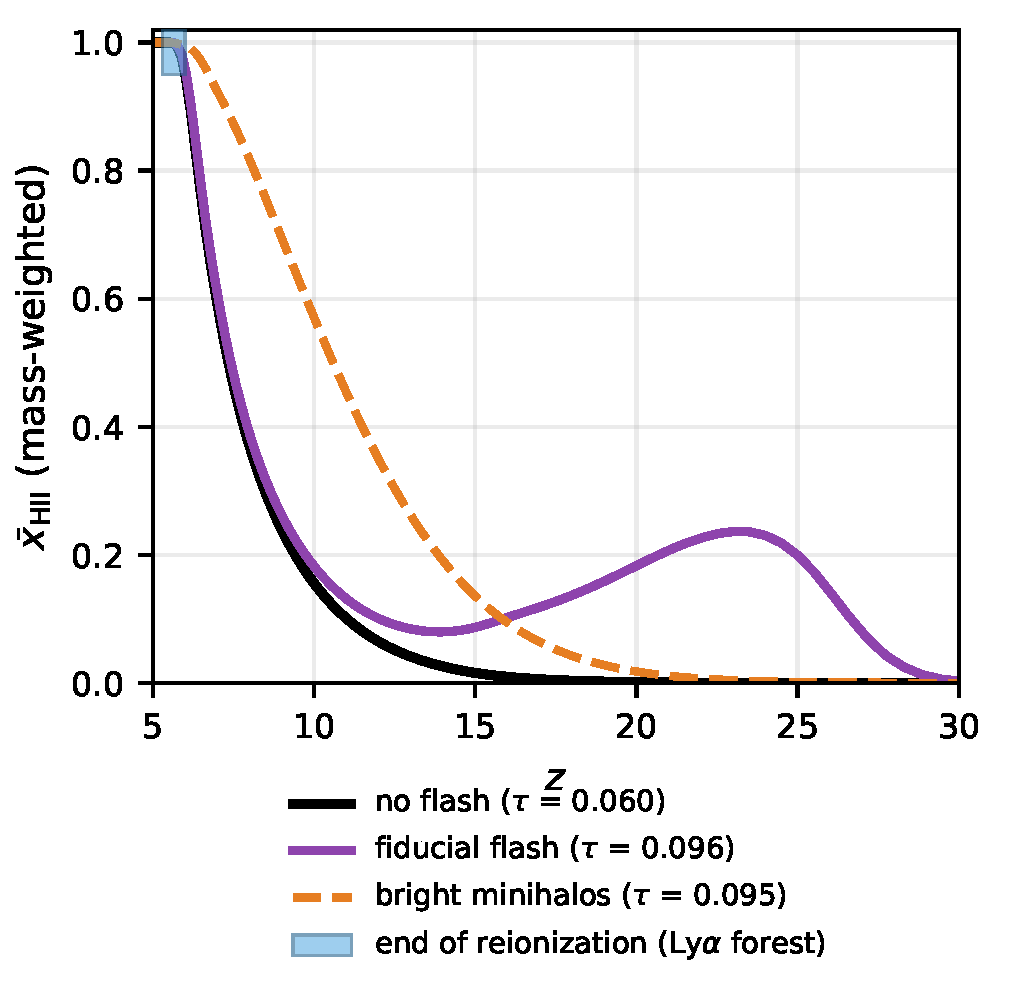
Mean ionized fraction vs. redshift: standard galaxy-driven reionization (black) and with an early Pop III.1 flash (purple). Figure: Bansal, Kern & Huterer (2026), CC BY 4.0
Background
The optical depth to reionization, $\tau$, measures how much CMB light was scattered by free electrons after the first stars and galaxies reionized the Universe (roughly $z \sim 6$–$30$). It is the least well-measured of the six parameters of the standard cosmological model. It is usually inferred from the reionization bump, a feature in the CMB E-mode polarization on the very largest scales ($\ell \lesssim 10$). That signal is notoriously hard to measure: there are very few independent modes on the sky, and it is extremely sensitive to foregrounds and instrument systematics. Planck's low value ($\tau \approx 0.054$) compared with WMAP's earlier $\tau \approx 0.089$ raised some eyebrows when it was published. Turning the data into a constraint also often relies on models of early star and galaxy formation, which are poorly known at high redshift.
In 2025, $\tau$ suddenly became much more interesting to me. Two papers (Sailer et al.; Jhaveri, Karwal & Hu) showed that much of the preference for dynamical dark energy and for a very low neutrino mass in DESI BAO + CMB (see the tensions page) traces back to the low $\tau$ preferred by the CMB polarization data. Taking $\tau \approx 0.09$ instead reduces the preference for evolving dark energy from about $3\sigma$ to about $1.5\sigma$. The reason is a parameter degeneracy: when the small-scale CMB data and CMB lensing are fit with a higher $\tau$, the inferred matter density $\Omega_m$ comes out lower, closer to the value preferred by BAO.
With no new full-sky CMB polarization mission coming soon (LiteBIRD may change that), there is growing interest in constraining $\tau$ with secondary CMB anisotropies. One of the most promising is the kinetic Sunyaev–Zel'dovich (kSZ) effect. Free electrons moving with a bulk velocity Doppler-shift the CMB photons they scatter. This leaves the blackbody spectrum intact, unlike the thermal SZ effect from hot cluster gas. The kSZ signal has two components. The late-time kSZ comes from after reionization, from density and velocity fluctuations of the fully ionized gas. The patchy kSZ comes from the epoch of reionization itself, when the Universe was a patchwork of ionized bubbles and neutral gas, and is sourced by fluctuations in the free-electron fraction. Its amplitude depends on how long reionization lasted and how large the bubbles were, which makes it an independent probe of reionization and therefore of $\tau$.
My Work
Patchy kSZ measurements from the South Pole Telescope, combined with the end of reionization at $z \approx 6$ from the Ly$\alpha$ forest, also seem to prefer a low $\tau \approx 0.055$. But there's a catch: this assumes a standard, monotonic reionization history driven by galaxies (the black curve in the figure above). However, reionization may also have had an early, transient phase, for example a "flash" from supermassive Population III stars at $z \sim 20$–$25$ (Tan 2025), shown by the purple curve. This flash ionizes many small bubbles, which carry their kSZ power at much smaller angular scales ($\ell \sim 20{,}000$) than current experiments probe. It can therefore raise $\tau$ substantially while only modestly increasing the patchy kSZ signal at $\ell = 3000$. This is precisely what we show in our recent work, using self-consistent simulations of such a flash.
I worked on this project with Nicholas Kern, a NASA Hubble Fellow at Michigan, and my advisor Dragan Huterer. While Nick took charge of implementing the transient reionization model, with its ionizing, Lyman–Werner and X-ray feedback, in the semi-numerical code 21cmFAST, I looked into the implications of this model for the patchy kSZ effect. We find that a flash can raise the optical depth to $\tau \approx 0.09$ while remaining consistent with the Ly$\alpha$ forest and with current kSZ limits for most foreground models. Looking ahead, the Simons Observatory, combined with complementary probes, could pin down the optical depth accumulated above $z = 12$ to about $\pm 0.008$ in this scenario. In a companion paper we show that the same flash leaves distinctive signatures in the 21 cm signal from Cosmic Dawn, which future radio arrays like the SKA could detect.